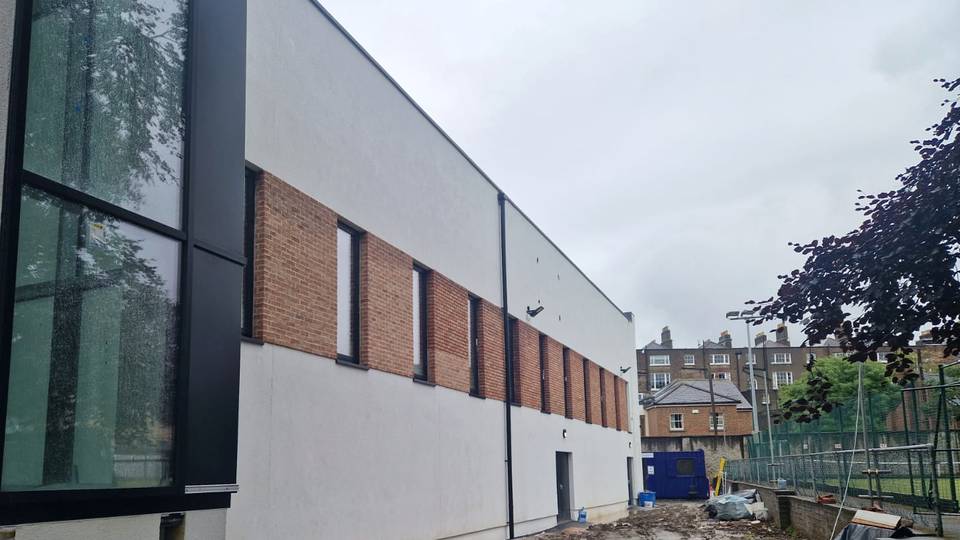
Loreto College wanted to take its 1980s sports hall off gas. The design was already well advanced when Carrig Energy came on board in late 2024. We secured SEAI funding for the works, managed the grant through to payment, and verified the savings a year later.
SEAI grant support covered about 29% of the total project cost. Savings verified to IPMVP, May 2026.
Background
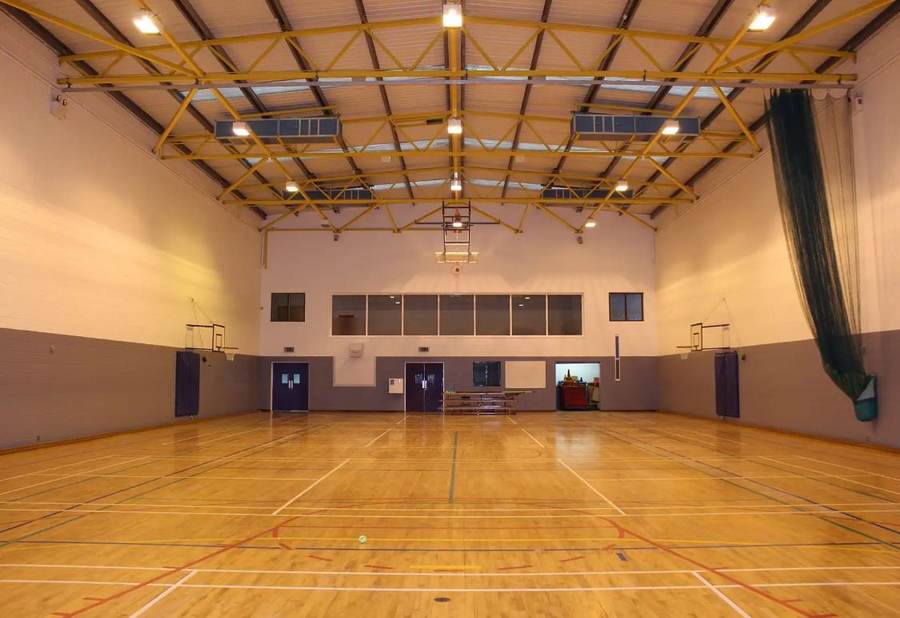
Loreto College’s sports hall on St Stephen’s Green was built around 1988. It is a two-storey, 970 m² building with a sports hall, gym, changing rooms and offices, used for PE during the day and by the community in the evenings and at weekends.
Before the works, it was heated by a gas boiler and a gas water heater, both running at around 70% efficiency. The walls and roof were only partly insulated, the windows and doors were old, and the lighting had few controls. In 2023 the hall used 215,406 kWh of energy, 71% of it gas, at a cost of over €42,000.
The college had a design team in place for a full renovation and extension of the hall. What it needed was a way to fund the energy upgrade.
The challenge
A design already well advanced
The architects and engineers had already specified the works. The SEAI application had to be built around that design, not the other way round.
A tight timeline
The application had to go in within weeks, with an energy audit, costings and supporting documents ready for SEAI.
A shared electricity meter
The sports hall shares its electricity supply with the convent buildings next door. This made it harder to show the savings once the works were done.
How Carrig Energy helped
Loreto College engaged Carrig Energy Consultancy as Project Coordinator for the SEAI grant.
- Energy audit and grant figuresWe arranged an ASHRAE Level II energy audit of the hall and matched the design team’s measures to SEAI’s fabric-first requirements. We then prepared the grant calculations.
- ApplicationWe prepared and submitted the SEAI application in November 2024, with the audit, scope of works, costings and declarations.
- Delivery and claimWe worked with the design team and contractor during the works, gathered the certificates and evidence SEAI needs, and managed the SEAI site inspection. The project passed inspection in November 2025 and the grant was paid.
- Measurement and verificationWe verified the savings using IPMVP Option A, which suits a building on a shared meter. The M&V report was completed in May 2026.
Since 2012, Carrig Energy Consultancy has coordinated SEAI-funded energy upgrades to more than 1,000 homes and 60 community and commercial buildings: €21.4 million of investment and 15 GWh of energy saved.
Measures installed
- External wall insulation — about 1,100 m², bringing the U-value from around 1.00 to 0.27 W/m²K.
- Roof insulation — the metal-clad hall roof and flat roofs, to a U-value of 0.16 W/m²K.
- New windows, doors and rooflights — replacing old double-glazed units and uninsulated timber doors.
- Air-to-water heat pump — a 115 kW unit with a 2,000-litre cylinder, supplying ceiling cassettes and hot water. The gas supply to the hall was disconnected.
- LED lighting and controls — with occupancy sensors.
- Heat recovery ventilation — three units, funded by the college itself and not claimed under the grant.
Results
Savings above target. SEAI’s target for the project was 111,739 kWh a year. The verified saving is 144,738 kWh a year, 130% of the target. Counting only the measures claimed under the grant, it is still 126%.
Off gas. The hall no longer uses any gas. All heating and hot water now comes from the heat pump.
Carbon and cost. The upgrade saves about 36 tonnes of CO₂ a year, or 43 tonnes on the college’s renewable electricity tariff. Annual energy costs for the hall are estimated to be €12,000 to €15,000 lower than before.
Lessons for building owners and design teams
- It’s not too late once the design is doneEarly involvement is ideal, but funding is often still available when the design is well advanced, as long as works have not started.
- Fabric and heat pump togetherInsulating first means a smaller heat load, so the heat pump runs efficiently at low temperatures.
- Plan for measurement from the startA shared meter can be worked around, but a dedicated meter on the heat pump makes verifying savings simpler.
Planning a building upgrade?
We work with schools, community groups and businesses to find the right SEAI funding, prepare the application and manage the grant through to payment. Early involvement is best, but funding is often still available at later stages.